Spectral Unmixing in Flow Cytometry: Control Options
01 — Objective: To surface intrinsic limitations of standard compensation beads, before presenting the client's reagent as an efficacious solution to these known challenges.
02 — Material:
Flow cytometry is a widely used cell analysis platform for characterizing cell populations based on a diversity of physical attributes and markers of interest. Applications range from profiling the activities of immune cells to evaluating cell type composition of lysed whole tissues. As a result, flow cytometry is an indispensable tool in immunology, hematology, and other classes of both clinical and basic research.
In conventional flow cytometry, the signal from each fluorophore is measured by a single detector. Bandpass optical filters are set such that only a narrow range of the emission profile for each designated fluor is captured by a detector, while the rest of the signature is discarded. This is crucial for matching each emission peak with its corresponding fluorescent label. Still, even after only a narrow range of the spectral profile is captured, fluors emit over a range of wavelengths, and there is often overlap. This can cause the signal from one dye to be picked up by the primary detector of another, in a process called fluorescence spillover. When this occurs, the detector alone cannot differentiate which fluor the signal is coming from, therefore, a process called compensation is needed to ensure that the signal recorded by each detector is accurately paired to the corresponding dye.
In spectral flow cytometry, not only the peak emission range, but the entire emission signature is recorded for each dye using a set of detectors. The unique spectra for every fluor are differentiated through a process called spectral unmixing, which considers differences in emission across a broader range of wavelengths. Although mathematically distinct and necessitating distinct system configurations, basic compensation and spectral unmixing achieve a similar end goal, and both rely on single stained controls during experimental set-up.
When the entire spectral profile of each dye is captured, this information can be used for downstream optical analysis, opening up doors for more comprehensive investigation. Furthermore, similar dyes that could previously not be differentiated by conventional flow cytometry can be used side-by-side in spectral flow experiments. Naturally, this also means that a greater number of fluorophores can be used simultaneously, and the maximum is limited only by the total number of detectors in the instrument.
Due to these unique advantages of spectral flow cytometry, its popularity has increased significantly over the past decade, as researchers continue to rely on this technology for a widening breadth of applications. Still, because spectral flow relies on the sum of the differences in emission signatures to differentiate between dyes, there are a greater number of considerations in designing and controlling for a spectral flow experiment, and spectral unmixing calculations are generally more intensive. Rigorous experimental setup and unmixing are especially vital for the use of spectral flow in a clinical setting.
Notably, increased reliance on more complex spectral flow experiments necessitates higher-performing control reagents.
There are several obstacles to successful unmixing in spectral flow cytometry that may present during a given workflow.
First, in spectral flow cytometry it is even more essential for each control to achieve a maximum fluorescence intensity without reaching saturation. This is required for capturing the full emission profile of each fluorophore across the total array of detectors, allowing each dye to be accurately individuated from the rest of the panel. Without a bright reference signal for each single-dye control, it is challenging to differentiate the dye from adjacent spectral signatures or even from autofluorescence. This can lend to a phenomenon called “negative spread,” wherein the negative population is incorrectly identified by the algorithm as having negative (rather than low or negligible) values. Avoiding this error is especially vital in the detection of rare cell populations, as this unmixing spreading error can cause them to evade identification entirely.
Accounting for baseline autofluorescence is another crucial component of experiment setup in flow cytometry. Overall, high autofluorescence decreases the ratio of signal to noise, potentially drowning out biologically relevant signals. Minimizing autofluorescence is especially pertinent in experiments where the user intends to evaluate weakly positive markers. Using a control that, like real cells, emits a low, even range of emission across the spectrum, is especially helpful if the user intends to include dyes that emit in the far violet or infrared ends of the spectrum. Baseline autofluorescence can vary greatly depending on the sample type, therefore, to optimize autofluorescence extraction, a researcher should aim to use the same kind of sample for unstained controls, single-stained references, and experimental samples.
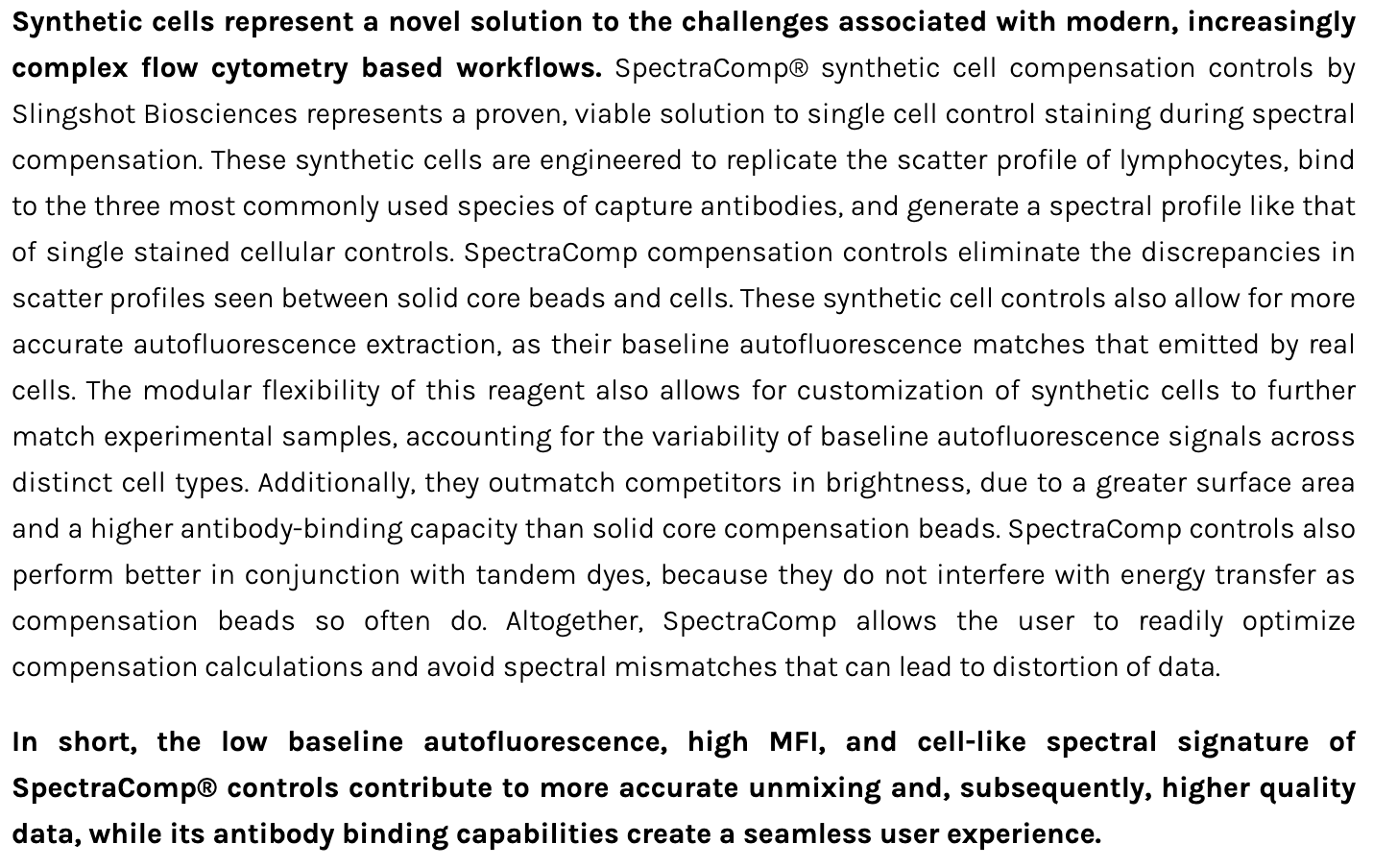
Yet this is often not the case, and instead, solid-core plastic beads are used, as they are convenient, timesaving, and allow researchers to conserve valuable sample. Still, these polystyrene compensation beads generally have a baseline autofluorescence much higher than that of biological cells.
As mentioned, spectral unmixing relies on full emission profiles to differentiate between signals from distinct fluorophores. This allows more colors to be used in a single experiment, and even allows multiple colors with similar emission peaks to be used side-by-side. That said, relatively small differences in emission profiles are important for separating fluorophores during spectral unmixing. Ideally, single stained controls should replicate the spectra of stained cell samples. Conventional compensation beads, while convenient, fail to do so. Mismatches in the spectra generated by compensation controls and samples can lead to over or under-compensation downstream. This poses a direct risk to data integrity, which is impacted by the accuracy with which spectral compensation is performed, especially as the user designs more complicated multicolor experiments.
03 — Impact: Positioned the client's solution within a research need, while neutralizing potential skepticism by acknowledging the drawbacks of existing controls, turning thorough examination into brand credibility.

Post a comment